Why MCMC produces valid samples from posterior distributions
The mathematical foundations that guarantee convergence
Detailed balance and why it ensures the correct stationary distribution
Ergodic theorems that justify using sample averages for posterior expectations
The connection between Metropolis-Hastings, Gibbs sampling, and general Markov chain theory
The Fundamental Problem
In Bayesian inference, we repeatedly face the same computational challenge: given a posterior distribution \[p(\theta | y) = \frac{p(y|\theta)p(\theta)}{\int p(y|\theta)p(\theta)d\theta}\]
we need to:
\[
\\[4cm]
\]
The problem: The normalizing constant \(\int p(y|\theta)p(\theta)d\theta\) is often intractable, and direct sampling is impossible for complex posteriors.
What MCMC Promises
MCMC methods construct a sequence of random variables \(\theta^{(0)}, \theta^{(1)}, \theta^{(2)}, \ldots\) such that:
We only need to evaluate \(p(\theta|y)\) up to a normalizing constant
The samples eventually “look like” draws from \(p(\theta|y)\)
Sample averages converge to true expectations
Today’s Goal: Understand why these promises are kept.
Notation: Throughout this lecture, we will denote our target distribution by \(p_0(\theta)\). In Bayesian applications, \(p_0(\theta) = p(\theta|y)\), but the theory applies to any target distribution.
2 Markov Chain Fundamentals
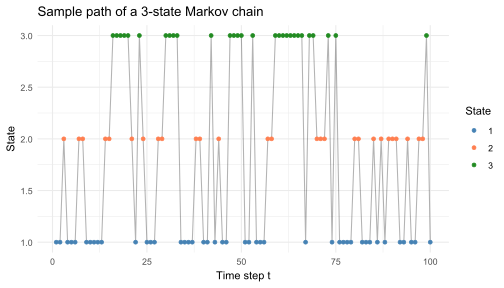
2.1 Definition: Markov Chain
Definition
A sequence of random variables \(\{\theta^{(t)}\}_{t=0}^{\infty}\) is a Markov chain if:
The dynamics of the chain are governed by the transition kernel\(K(\theta, \theta')\) which gives the probability (density) of moving from \(\theta\) to \(\theta'\): \[K(\theta, A) = P(\theta^{(t+1)} \in A | \theta^{(t)} = \theta)\]
For continuous state spaces, think of \(K(\theta,\theta')\) as the density of \(\theta^{(t+1)}\) given \(\theta^{(t)} = \theta\).
For MCMC to work, our Markov chains must have these:
Three Essential Properties
Irreducibility: The chain can reach any state from any other state
Aperiodicity: The chain doesn’t get stuck in deterministic cycles
Stationarity: There exists a distribution \(p_0\) that is preserved by the chain
3 Stationary Distributions
3.1 Definition: Stationary Distribution
Definition
A distribution \(p_0\) is stationary (or invariant) for a Markov chain with kernel \(K\) if:
\[p_0(\theta') = \underline{\hspace{6cm}}\]
\[
\\[4cm]
\]
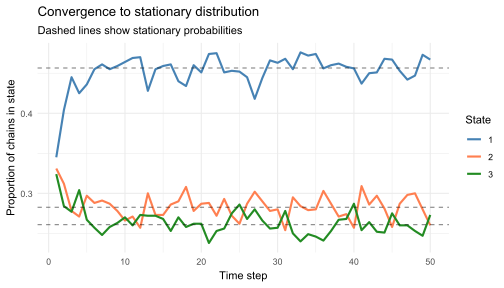
# Compute stationary distribution of our 3-state chaineigen_result <-eigen(t(P))stationary <- eigen_result$vectors[,1]stationary <- stationary /sum(stationary)stationary <-Re(stationary)# Show convergence to stationary distributionn_chains <-1000n_steps <-50final_states <-matrix(0, nrow = n_chains, ncol = n_steps)for(chain in1:n_chains) { state <-sample(1:3, 1) # Random startfor(t in1:n_steps) { final_states[chain, t] <- state state <-sample(1:3, 1, prob = P[state,]) }}# Compute empirical distribution at each timeempirical <-data.frame()for(t in1:n_steps) { props <-table(factor(final_states[,t], levels=1:3)) / n_chains empirical <-rbind(empirical, data.frame(t = t, state =1:3, proportion =as.numeric(props)))}ggplot(empirical, aes(x = t, y = proportion, color =factor(state))) +geom_line(linewidth =1) +geom_hline(aes(yintercept = stationary[1]), linetype ="dashed", alpha =0.5) +geom_hline(aes(yintercept = stationary[2]), linetype ="dashed", alpha =0.5) +geom_hline(aes(yintercept = stationary[3]), linetype ="dashed", alpha =0.5) +scale_color_manual(values =c("steelblue", "coral", "forestgreen"),name ="State") +labs(x ="Time step", y ="Proportion of chains in state",title ="Convergence to stationary distribution",subtitle ="Dashed lines show stationary probabilities") +theme_minimal()
Stationary distribution: starting from p₀ preserves p₀
3.2 Detailed Balance: A Sufficient Condition
How do we ensure our chain has \(p_0\) as its stationary distribution?
Theorem: Detailed Balance (Reversibility)
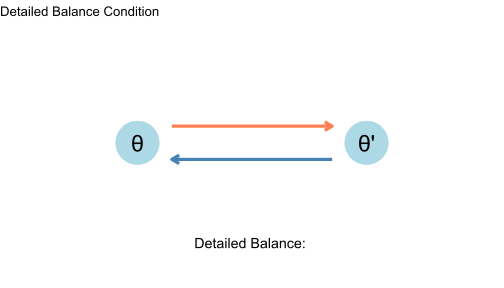
If a transition kernel \(K\) satisfies detailed balance with respect to \(p_0\):
\[\underline{\hspace{4cm}} = \underline{\hspace{4cm}} \quad \text{for all } \theta, \theta'\]
then \(p_0\) is a stationary distribution for \(K\).
Interpretation: Detailed balance means the “probability flow” from \(\theta\) to \(\theta'\) equals the flow from \(\theta'\) to \(\theta\) under \(p_0\).
Proof of Detailed Balance Theorem
Proof:
\[
\\[6cm]
\]
Detailed balance: probability flows balance at equilibrium
4 The Metropolis-Hastings Algorithm
4.1 Algorithm Construction
Given a target distribution \(p_0(\theta)\) (known up to normalizing constant) and a proposal distribution \(J(\theta'|\theta)\):
With probability \(\alpha\), set \(\theta^{(t+1)} = \theta^*\); otherwise \(\theta^{(t+1)} = \theta^{(t)}\)
Key insight: If \(p_0(\theta) = p(\theta|y) \propto p(y|\theta)p(\theta)\), the normalizing constant cancels in \(r\)!
Why M-H Works: Detailed Balance Verification
Important
Claim: The M-H kernel satisfies detailed balance with respect to \(p_0\).
Verification of Detailed Balance for M-H
\[
\\[8cm]
\]
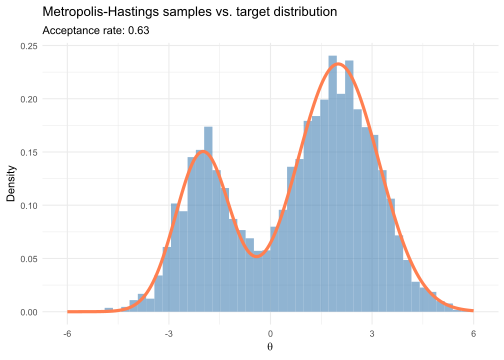
# Target: mixture of two normalstarget <-function(x) {0.3*dnorm(x, -2, 0.8) +0.7*dnorm(x, 2, 1.2)}# M-H with normal proposalmh_sample <-function(n_iter, proposal_sd =1) { samples <-numeric(n_iter) samples[1] <-0 accepted <-0for(t in2:n_iter) { current <- samples[t-1] proposal <-rnorm(1, current, proposal_sd)# Ratio r (symmetric proposal, so J cancels) r <-target(proposal) /target(current) alpha <-min(1, r)if(runif(1) < alpha) { samples[t] <- proposal accepted <- accepted +1 } else { samples[t] <- current } }list(samples = samples, acceptance_rate = accepted / (n_iter -1))}result <-mh_sample(10000, proposal_sd =2)samples <- result$samples# Plotx_seq <-seq(-6, 6, length.out =200)df_target <-data.frame(x = x_seq, density =target(x_seq))df_samples <-data.frame(x = samples[1001:10000]) # Discard burn-inggplot() +geom_histogram(data = df_samples, aes(x = x, y =after_stat(density)), bins =50, fill ="steelblue", alpha =0.6) +geom_line(data = df_target, aes(x = x, y = density), color ="coral", linewidth =1.5) +labs(x =expression(theta), y ="Density",title ="Metropolis-Hastings samples vs. target distribution",subtitle =paste("Acceptance rate:", round(result$acceptance_rate, 3))) +theme_minimal()
Metropolis-Hastings sampling from a mixture of normals
5 Ergodic Theorems: From Samples to Estimates
5.1 The Law of Large Numbers for Markov Chains
Ergodic Theorem
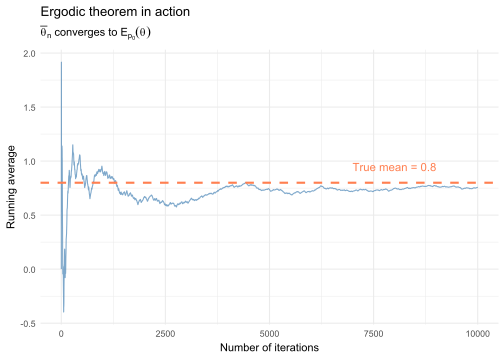
If \(\{\theta^{(t)}\}\) is an irreducible, aperiodic Markov chain with stationary distribution \(p_0\), then for any function \(g\) with \(E_{p_0}[|g(\theta)|] < \infty\):
This is the fundamental result that makes MCMC useful for Bayesian inference!
When \(p_0(\theta) = p(\theta|y)\), we have: \[\frac{1}{n}\sum_{t=1}^{n} g(\theta^{(t)}) \xrightarrow{a.s.} E[g(\theta)|y]\]
Visualizing Ergodicity
# Use samples from previous M-H run# True mean of targettrue_mean <-0.3* (-2) +0.7*2# = 0.8# Compute running averagesn <-length(samples)running_avg <-cumsum(samples) / (1:n)df_ergodic <-data.frame(t =1:n,running_avg = running_avg)ggplot(df_ergodic, aes(x = t, y = running_avg)) +geom_line(color ="steelblue", alpha =0.7) +geom_hline(yintercept = true_mean, color ="coral", linewidth =1, linetype ="dashed") +annotate("text", x =8000, y = true_mean +0.15, label =paste("True mean =", true_mean), color ="coral", size =4) +labs(x ="Number of iterations", y ="Running average",title ="Ergodic theorem in action",subtitle =expression(paste(bar(theta)[n], " converges to ", E[p[0]](theta)))) +theme_minimal()
Ergodic averages converging to true expectation
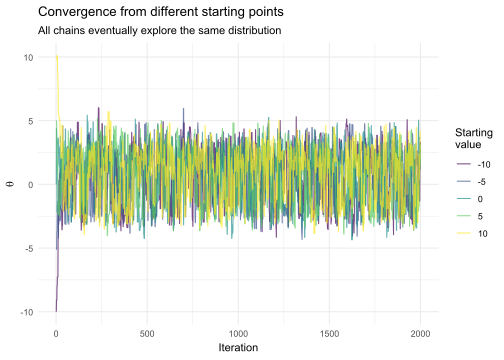
Why Initial Values Don’t Matter (Eventually)
# Run multiple chains from different starting pointsstarting_points <-c(-10, -5, 0, 5, 10)n_iter <-2000all_chains <-data.frame()for(start in starting_points) { samples_chain <-numeric(n_iter) samples_chain[1] <- startfor(t in2:n_iter) { current <- samples_chain[t-1] proposal <-rnorm(1, current, 2) r <-target(proposal) /target(current) alpha <-min(1, r) samples_chain[t] <-ifelse(runif(1) < alpha, proposal, current) } all_chains <-rbind(all_chains, data.frame(t =1:n_iter, value = samples_chain, start =factor(start)))}ggplot(all_chains, aes(x = t, y = value, color = start)) +geom_line(alpha =0.7) +scale_color_viridis_d(name ="Starting\nvalue") +labs(x ="Iteration", y =expression(theta),title ="Convergence from different starting points",subtitle ="All chains eventually explore the same distribution") +theme_minimal()
Chains from different starting points converge to the same distribution
6 Irreducibility and Aperiodicity
Definition: Irreducibility
Definition
A Markov chain is irreducible if for any two states \(\theta\) and \(\theta'\), there exists \(n > 0\) such that
\[
\\[3cm]
\]
For M-H: If the proposal \(J(\theta'|\theta) > 0\) for all \(\theta, \theta'\) (e.g., Gaussian proposals), and the target \(p_0(\theta) > 0\) everywhere on its support, then the chain is irreducible.
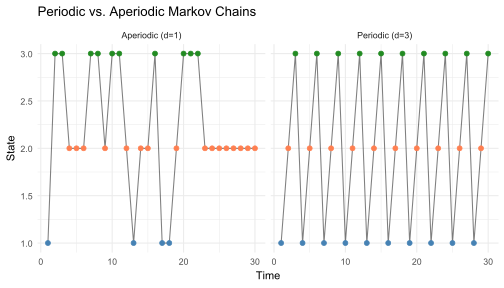
Definition: Aperiodicity
Definition
The period of state \(\theta\) is:
\[
d_\theta = \underline{\hspace{5cm}}
\]
\[
\\[3cm]
\]
For M-H: The rejection mechanism guarantees aperiodicity! If \(\theta^*\) is proposed and rejected, we stay at \(\theta^{(t)}\), so \(K(\theta, \theta) > 0\) for states where proposals might be rejected.
# Example: deterministic cycle (periodic) vs. random (aperiodic)n <-30# Periodic chain (period 3)periodic <-numeric(n)periodic[1] <-1for(t in2:n) { periodic[t] <- (periodic[t-1] %%3) +1}# Aperiodic chain P_aperiodic <-matrix(c(0.5, 0.3, 0.2,0.2, 0.5, 0.3,0.3, 0.2, 0.5), nrow=3, byrow=TRUE)aperiodic <-numeric(n)aperiodic[1] <-1for(t in2:n) { aperiodic[t] <-sample(1:3, 1, prob = P_aperiodic[aperiodic[t-1],])}df_periodic <-data.frame(t =1:n, state = periodic, type ="Periodic (d=3)")df_aperiodic <-data.frame(t =1:n, state = aperiodic, type ="Aperiodic (d=1)")df_both <-rbind(df_periodic, df_aperiodic)ggplot(df_both, aes(x = t, y = state)) +geom_line(alpha =0.5) +geom_point(aes(color =factor(state)), size =2) +facet_wrap(~type) +scale_color_manual(values =c("steelblue", "coral", "forestgreen")) +labs(x ="Time", y ="State", color ="State",title ="Periodic vs. Aperiodic Markov Chains") +theme_minimal() +theme(legend.position ="none")
7 Convergence Theory
7.1 Total Variation Distance
Definition
The total variation distance between distributions \(\mu\) and \(\nu\) is:
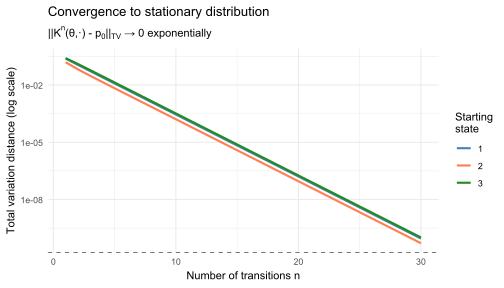
If a Markov chain is irreducible and aperiodic with stationary distribution \(p_0\), then for any starting distribution \(\mu\): \[\|K^n(\theta, \cdot) - p_0\|_{TV} \to 0 \text{ as } n \to \infty\]
If the chain is also positive recurrent (guaranteed for finite state spaces or under mild conditions), then \(p_0\) is unique.
\[
\\[3cm]
\]
7.3 Geometric Ergodicity
For practical MCMC, we often need stronger convergence guarantees:
Definition: Geometric Ergodicity
A chain is geometrically ergodic if there exist \(M < \infty\) and \(\rho < 1\) such that: \[\|K^n(\theta, \cdot) - p_0\|_{TV} \leq M(\theta)\rho^n\]
This ensures exponentially fast convergence and is needed for:
Central Limit Theorems for MCMC
Valid standard error estimates
# Illustrate convergence using our discrete chainP_matrix <-matrix(c(0.7, 0.2, 0.1,0.3, 0.4, 0.3,0.2, 0.3, 0.5), nrow=3, byrow=TRUE)# Stationary distributioneigen_result <-eigen(t(P_matrix))p0_stat <-Re(eigen_result$vectors[,1])p0_stat <- p0_stat /sum(p0_stat)# Compute TV distance over iterationsn_iter <-30tv_distances <-data.frame()for(start in1:3) { mu <-rep(0, 3) mu[start] <-1# Start in state 'start'for(n in1:n_iter) { mu <- mu %*% P_matrix tv_dist <-0.5*sum(abs(mu - p0_stat)) tv_distances <-rbind(tv_distances,data.frame(n = n, tv = tv_dist, start =factor(start))) }}ggplot(tv_distances, aes(x = n, y = tv, color = start)) +geom_line(linewidth =1) +geom_hline(yintercept =0, linetype ="dashed") +scale_y_log10() +scale_color_manual(values =c("steelblue", "coral", "forestgreen"),name ="Starting\nstate") +labs(x ="Number of transitions n", y ="Total variation distance (log scale)",title ="Convergence to stationary distribution",subtitle =expression(paste("||", K^n, "(θ,·) - p"[0], "||"[TV], " → 0 exponentially"))) +theme_minimal()
Warning in scale_y_log10(): log-10 transformation introduced infinite values.
Convergence in total variation distance (illustration)
8 The Gibbs Sampler as a Special Case
Gibbs Sampling
For \(\theta = (\theta_1, \ldots, \theta_p)\), the Gibbs sampler cycles through: \[
\theta_j^{(t+1)} \sim p\left(\theta_j \,\Big|\, \theta_{<j}^{(t+1)}, \theta_{>j}^{(t)}\right)
\]
Why Gibbs is a Special Case of M-H
The Gibbs sampler is M-H with a special proposal: propose \(\theta_j^*\) from the full conditional \(p(\theta_j | \theta_{-j})\).
HW Q: the acceptance probability is always 1.
Conclusion: Every proposal is accepted in Gibbs sampling because \(r = 1\)
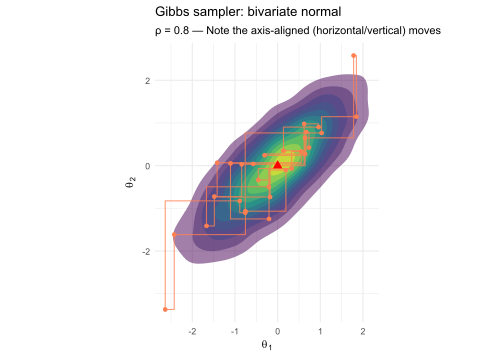
# Target: bivariate normal with correlationrho <-0.8# Gibbs sampler - storing intermediate steps to show axis-aligned movesgibbs_bivariate_with_path <-function(n_iter, rho) {# Store both the samples and the full path (including intermediate steps) samples <-matrix(0, n_iter, 2) samples[1,] <-c(0, 0)# Path will have 2 points per iteration (after theta1 update, after theta2 update) path <-matrix(0, n_iter *2, 2) path[1,] <- samples[1,] path[2,] <- samples[1,]for(t in2:n_iter) {# Current position current <- samples[t-1,]# Step 1: Sample theta1 | theta2 (horizontal move) new_theta1 <-rnorm(1, rho * current[2], sqrt(1- rho^2)) intermediate <-c(new_theta1, current[2])# Step 2: Sample theta2 | theta1 (vertical move) new_theta2 <-rnorm(1, rho * new_theta1, sqrt(1- rho^2)) final <-c(new_theta1, new_theta2) samples[t,] <- final path[(t-1)*2+1,] <- intermediate # After horizontal move path[(t-1)*2+2,] <- final # After vertical move }list(samples = samples, path = path)}result_gibbs <-gibbs_bivariate_with_path(2000, rho)samples_gibbs <- result_gibbs$samplespath_gibbs <- result_gibbs$pathdf_gibbs <-data.frame(x = samples_gibbs[,1], y = samples_gibbs[,2])# Show first 30 iterations as path (60 path points = 30 complete iterations)n_show <-30df_path <-data.frame(x = path_gibbs[1:(n_show*2), 1], y = path_gibbs[1:(n_show*2), 2],t =1:(n_show*2))# Also mark the iteration endpointsdf_points <-data.frame(x = samples_gibbs[1:n_show, 1],y = samples_gibbs[1:n_show, 2],t =1:n_show)ggplot() +stat_density_2d(data = df_gibbs, aes(x = x, y = y, fill =after_stat(level)),geom ="polygon", alpha =0.5) +scale_fill_viridis_c() +geom_path(data = df_path, aes(x = x, y = y), color ="coral", alpha =0.8, linewidth =0.5) +geom_point(data = df_points, aes(x = x, y = y), color ="coral", size =1.5) +geom_point(data = df_points[1,], aes(x = x, y = y),color ="red", size =3, shape =17) +labs(x =expression(theta[1]), y =expression(theta[2]),title ="Gibbs sampler: bivariate normal",subtitle =paste("ρ =", rho, "— Note the axis-aligned (horizontal/vertical) moves")) +theme_minimal() +theme(legend.position ="none") +coord_fixed()
Gibbs sampler for a bivariate normal
9 Practical Diagnostics
Checking Convergence
Since we can’t compute \(\|K^n - p_0\|_{TV}\) directly, we use heuristic diagnostics:
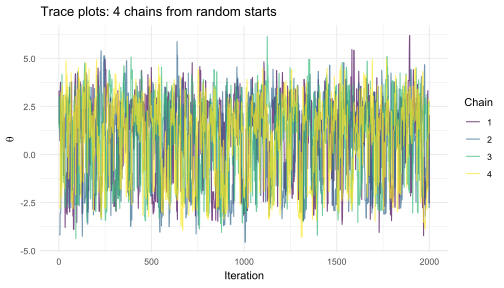
Trace Plots
# Multiple chains for the mixture targetn_chains <-4n_iter <-2000all_traces <-data.frame()for(chain in1:n_chains) { samples_tr <-numeric(n_iter) samples_tr[1] <-runif(1, -5, 5)for(t in2:n_iter) { proposal <-rnorm(1, samples_tr[t-1], 2) r <-target(proposal) /target(samples_tr[t-1]) alpha <-min(1, r) samples_tr[t] <-ifelse(runif(1) < alpha, proposal, samples_tr[t-1]) } all_traces <-rbind(all_traces,data.frame(t =1:n_iter, value = samples_tr, chain =factor(chain)))}ggplot(all_traces, aes(x = t, y = value, color = chain)) +geom_line(alpha =0.7) +scale_color_viridis_d() +labs(x ="Iteration", y =expression(theta), color ="Chain",title ="Trace plots: 4 chains from random starts") +theme_minimal()
Trace plots for assessing convergence
Gelman-Rubin Diagnostic (\(\hat{R}\))
Compares within-chain and between-chain variance. Want \(\hat{R} < 1.1\).
# Simple R-hat calculationcompute_rhat <-function(chains) { n <-nrow(chains) m <-ncol(chains) chain_means <-colMeans(chains) overall_mean <-mean(chains)# Between-chain variance B <- n *var(chain_means)# Within-chain variance W <-mean(apply(chains, 2, var))# Pooled variance estimate var_hat <- (n-1)/n * W + B/n# R-hatsqrt(var_hat / W)}# Convert to matrixchain_matrix <-matrix(all_traces$value, ncol = n_chains)rhat <-compute_rhat(chain_matrix[1001:2000,]) # After burn-incat("R-hat:", round(rhat, 3), "\n")
R-hat: 1.002
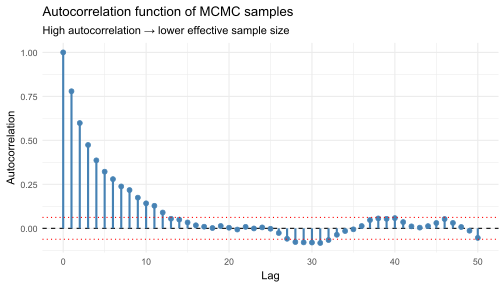
Effective Sample Size
# ACF for one chainone_chain <- all_traces$value[all_traces$chain ==1][1001:2000]acf_values <-acf(one_chain, lag.max =50, plot =FALSE)df_acf <-data.frame(lag = acf_values$lag, acf = acf_values$acf)ggplot(df_acf, aes(x = lag, y = acf)) +geom_hline(yintercept =0, linetype ="dashed") +geom_segment(aes(xend = lag, yend =0), color ="steelblue", linewidth =1) +geom_point(color ="steelblue", size =2) +geom_hline(yintercept =c(-1.96/sqrt(1000), 1.96/sqrt(1000)), linetype ="dotted", color ="red") +labs(x ="Lag", y ="Autocorrelation",title ="Autocorrelation function of MCMC samples",subtitle ="High autocorrelation → lower effective sample size") +theme_minimal()
Autocorrelation function - key to understanding effective sample size
10 Conclusions and Main Takeaways
The Logical Chain: Why MCMC Works
The Complete Picture
Design: Metropolis-Hastings constructs a kernel satisfying detailed balance with target \(p_0\)\[p_0(\theta)K(\theta,\theta') = p_0(\theta')K(\theta',\theta)\]
Stationarity: Detailed balance implies \(p_0\) is the stationary distribution \[\int K(\theta,\theta')p_0(\theta)d\theta = p_0(\theta')\]
Regularity: Sensible proposals ensure irreducibility and aperiodicity
Convergence: Fundamental theorem guarantees \(\theta^{(t)} \xrightarrow{d} p_0\)
Utility: Ergodic theorem justifies using sample averages for posterior expectations \[\frac{1}{n}\sum_{t=1}^{n} g(\theta^{(t)}) \xrightarrow{a.s.} E_{p_0}[g(\theta)]\]
Key Takeaways
Summary
We don’t need the normalizing constant because it cancels in the ratio \(r\)
Starting values don’t matter (asymptotically) due to the convergence theorem