Lecture 16: Metropolis Algorithm
1 Metropolis Algorithm
Recall, last time we discussed the grid-based approximation to the posterior distribution. This approach is not scalable to high-dimensional problems.
Goal: Estimate \(p(\theta\mid y)\)
How: We construct a Markov Chain \(\{\theta^{(1)},\ldots,\theta^{(s)}\}\). How to get the next sample \(\theta^{(s+1)}\)?
1.1 Metropolis Algorithm
Sample a proposal value \(\theta^*\) \[ \\[1cm] \]
Compute \(r=\) \[ \\[1cm] \]
\(\theta^{(s+1)}=\)
2 Normal Model with known variance
We will illustrate the Metropolis algorithm on the normal model with known variance. We have data \(y_1,\ldots,y_n\) and we want to estimate \(\theta\) in the model
Sampling model
\[ y_i\overset{iid}{\sim} N(\theta,\sigma^2),\qquad \text{ where $\sigma^2$ is known}. \]
Prior distribution
\[ \theta\sim N(\mu,t^2). \]
Posterior distribution
\[ \theta\mid y_1,\ldots,y_n\sim N\left(\frac{\frac{n}{\sigma^2}\bar{y}+\frac{1}{\tau^2}\mu}{\frac{n}{\sigma^2}+\frac{1}{\tau^2}},\frac{1}{\frac{n}{\sigma^2}+\frac{1}{\tau^2}}\right). \]
2.1 Setting up the Metropolis algorithm
\[ \sigma^2=1, \qquad \tau^2=1, \qquad \mu=5, \qquad n=5,\qquad y=(\ldots,\ldots). \] and we get
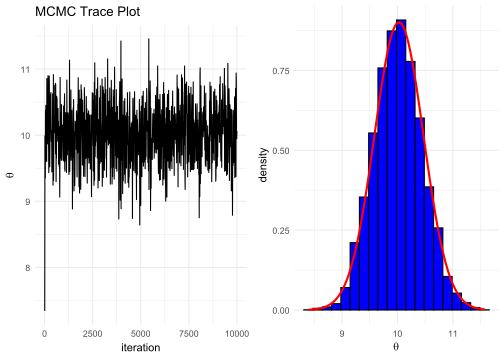
\[ \theta\mid y_1,\ldots,y_n\sim N(10.04,0.2). \]
Metropolis algorithm pseudocode
2.2 Results from the Metropolis algorithm for the normal model.
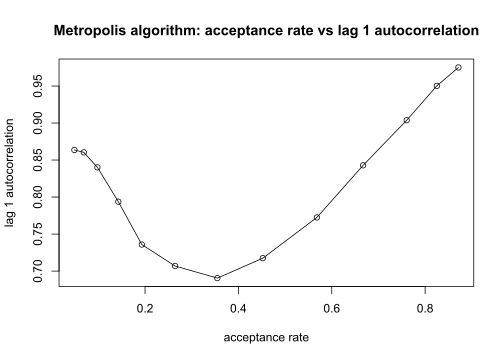
Q: Which parts of the graph correspond to under-dispersed (small proposal SD) and over-dispersed (large proposal SD) proposal distributions?
Markov chains under three different proposal distributions.
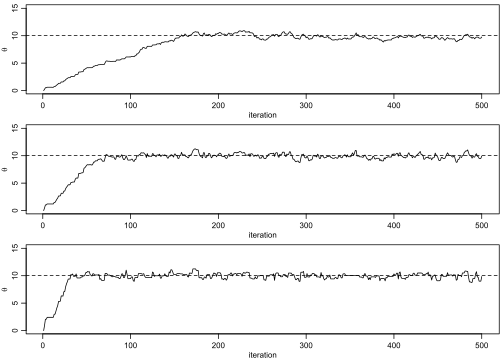
Q: Which of the three chains correspond to \(\delta^2=1/32\), \(\delta^2=2\) and \(\delta^2=64\)?
3 Poisson regression
- \(Y_i=\) number of eggs
- \(X_i=\) Age
\[ \log(E(Y_i\mid x_i))=\beta_1+\beta_2 x_i+\beta_3 x_i^2=\underline{\beta}^T\underline{x}_i \]
Prior distribution
\[ \underline{\beta}\sim N(\underline{0},100\times\underline{I}) \]
Proposal distribution
\[ \underline{\beta}^*\sim J(\underline{\beta}^* \mid \underline{\beta})=\hspace{10cm} \]
3.1 WWaFD
#### Back to sparrow data
load("../data/sparrows.RData")
set.seed(639)
fledged<-sparrows[,1] ; age<-sparrows[,2] ; age2<-age^2
fit.mle<-glm(fledged~age+age2,family="poisson")
summary(fit.mle)
Call:
glm(formula = fledged ~ age + age2, family = "poisson")

Coefficients:
            Estimate Std. Error z value Pr(>|z|)
(Intercept)  0.27662    0.44219   0.626   0.5316
age          0.68174    0.33850   2.014   0.0440 *
age2        -0.13451    0.05786  -2.325   0.0201 *
---
Signif. codes:  0 '***' 0.001 '**' 0.01 '*' 0.05 '.' 0.1 ' ' 1

(Dispersion parameter for poisson family taken to be 1)

    Null deviance: 76.081  on 51  degrees of freedom
Residual deviance: 67.837  on 49  degrees of freedom
AIC: 198.78

Number of Fisher Scoring iterations: 5
3.2 WWaBD
#### Poisson regression MCMC
  load("../data/sparrows.RData")
  fledged <- sparrows[, 1] ; age <- sparrows[, 2] ; age2 <- age^2

  y <- fledged
  X <- cbind(rep(1, length(y)), age, age^2)
  yX <- cbind(y, X)
  colnames(yX) <- c("fledged", "intercept", "age", "age2")

  n_pois <- length(y)
  p <- dim(X)[2]

  pmn.beta <- rep(0, p)
  psd.beta <- rep(10, p)

  var.prop <- var(log(y + 1/2)) * solve(t(X) %*% X)
  beta <- rep(0, p) ; S <- 10000 ; ac <- 0
  BETA <- matrix(0, nrow = S, ncol = p)
  set.seed(639)

  rmvnorm <- function(n, mu, Sigma) {
    E <- matrix(rnorm(n * length(mu)), n, length(mu))
    t(t(E %*% chol(Sigma)) + c(mu))
  }

  for(s in 1:S) {
    beta.p <- t(rmvnorm(1, beta, var.prop))

    lhr <- sum(dpois(y, exp(X %*% beta.p), log = T)) -
           sum(dpois(y, exp(X %*% beta), log = T)) +
           sum(dnorm(beta.p, pmn.beta, psd.beta, log = T)) -
           sum(dnorm(beta, pmn.beta, psd.beta, log = T))

    if(log(runif(1)) < lhr) { beta <- beta.p; ac <- ac + 1 }

    BETA[s,] <- beta
  }

  ac_rate <- ac / S
  eff_size <- apply(BETA, 2, effectiveSize)
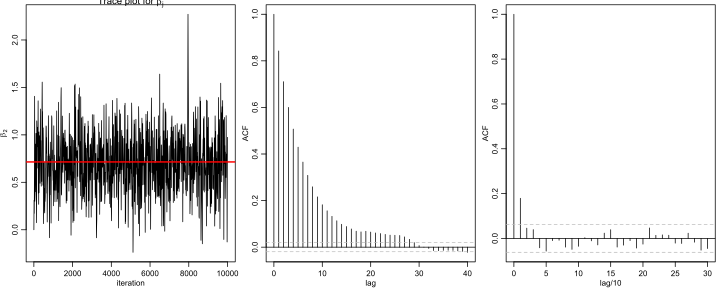
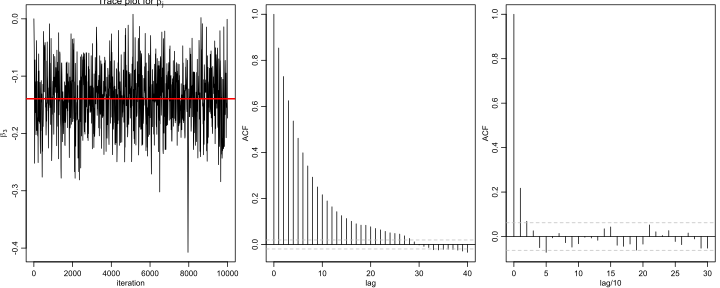
Acceptance rate: 0.417 Effective sample sizes:[1] 883.2414 854.9256 791.2289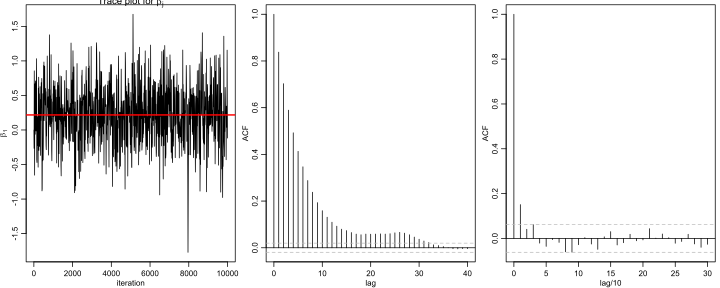
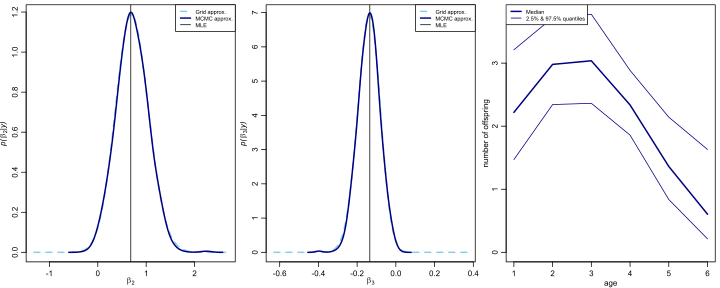
3.3 MCMC approximations to the posterior marginal distributions of \(\beta_2\) and \(\beta_3\)