     pretest posttest
[1,]      59       77
[2,]      43       39
[3,]      34       46
[4,]      32       26
[5,]      42       38
[6,]      38       43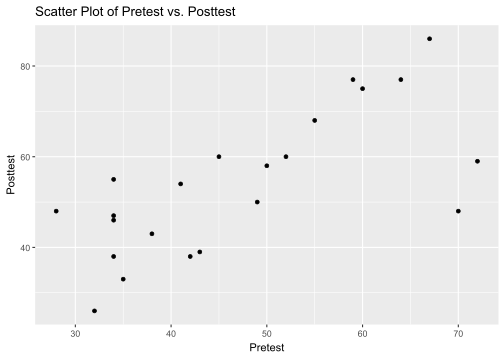
Refer to figures in the lectures please
(diagram to be posted to the website later)
Recall, we introduced Wishart distribution as a distribution of sample unscaled covariance matrices (or sample sum of squares), and we realized that Inverse-Wishart is a convenient semi-conjugate prior for the covariance matrix.
To sample a covariance matrix \(\underline\Sigma\) from Inv-Wishart
The last line produces \(\Sigma\sim Inv-Wishart(\nu_0,S_0^{-1})\)
Here, the precision matrix \(\underline\Sigma^{-1}\sim\ \text{Wishart} \left(\nu_{0}, \underline{S}_{0}^{-1}\right)\) and the variance-covariance matrix \(\underline\Sigma\sim \text{Inv-Wishart} \left(\nu_{0}, \underline{S}_{0}^{-1}\right)\).
\[ \begin{aligned} \mathrm{E}\left[\underline\Sigma^{-1}\right] & =\nu_{0}\ \underline{S}_{0}^{-1} \\ \mathrm{E}[\underline\Sigma] & =\frac{1}{\nu_{0}-p-1}\left(\underline{S}_{0}^{-1}\right)^{-1}=\frac{1}{\nu_{0}-p-1} \underline{S}_{0} . \end{aligned} \]
Exercise: Prove the first statement using the definition of the Wishart distribution.
The parameters of the Inv-Wishart distribution govern the mean and the variance of the variance-covariance matrix \(\underline{\Sigma}\). The degree of freedom, \(\nu\) governs the spread of our prior around the mean, the parameter \(\underline{S}_0\) controls the mean of the variance-covariance matrix.
Assume we know the prior expectation of the variance-covariance matrix is \(\underline\Sigma_{0}\). Then:
Note: The lowest possible value for \(\nu_{0}\), such that the Wishart (and Inv-Wishart) yields a positive definite matrix is \(\nu_0=p+2\).
Last time we derived the full conditional of the mean \(\underline\theta\), i.e. \(p(\underline\theta\mid data, \underline\Sigma)\). We employed the fact that the joint sampling model, as a function of \(\underline\theta\), is exponential to the power of the quadratic form in \(\underline\theta\). This allowed us to recognize the kernel of a multivariate normal distribution, and derive the full conditional distribution of \(\underline\theta\). Let us perform a similar trick for the full conditional of \(\underline\Sigma\).
The joint sampling model: \[ p\left(\underline{y}_{1}, \ldots, \underline{y}_{n} \mid \underline{\theta}, \Sigma\right)=(2 \pi)^{-n p / 2}|\Sigma|^{-n / 2} \exp \left\{-\sum_{i=1}^{n}\left(\underline{y}_{i}-\underline{\theta}\right)^{T} \Sigma^{-1}\left(\underline{y}_{i}-\underline{\theta}\right) / 2\right\} . \]
We will need to rework the above in the form that will allow us to recognize the kernel of an inverse-Wishart distribution. To do this, we will need the following fact about traces:
Linear Algebra Fact: \[ \operatorname{tr}\left( \underline{B A}\underline{B}^{T}\right)= \operatorname{tr}\left(\underline{B}^{T} \underline{B A}\right)=\sum_{k=1}^{K} \underline{b}_{k}^{T} \underline{A} \underline{b}_{k}, \] where the matrix \(\underline{B}\) is \[ \underline{B}= \begin{bmatrix} - & \underline{b}_1^T & -\\ - & \underline{b}_2^T & -\\ \vdots & \vdots & \vdots\\ - & \underline{b}_K^T & - \end{bmatrix} \]
Using this fact we have:
\[ \begin{aligned} \sum_{i=1}^{n}\left(\underline{y}_{i}-\underline{\theta}\right)^{T} \underline\Sigma^{-1}\left(\underline{y}_{i}-\underline{\theta}\right) &= tr\left(\underline{Y}_\theta^T\underline{Y}_\theta\,\underline\Sigma^{-1}\right)\\ &= tr\left(\underline{S}_\theta \underline\Sigma^{-1}\right), \end{aligned} \]
where \(\underline{S}_\theta\) is the sample sum of squares matrix for the data centered at \(\underline\theta\): \[ \underline{S}_\theta=\underline{Y}_\theta^T\underline{Y}_\theta=\sum_{i=1}^{n}\left(\underline{y}_{i}-\underline{\theta}\right)\left(\underline{y}_{i}-\underline{\theta}\right)^{T}, \]
and \[ \underline{Y}_\theta= \begin{bmatrix} -&(\underline{y}_1-\underline{\theta})^T&-\\ -&(\underline{y}_2-\underline{\theta})^T&-\\ \vdots&\vdots&\vdots\\ -&(\underline{y}_n-\underline{\theta})^T&- \end{bmatrix} \]
Thus, the full conditional for \(\underline\Sigma\) is straightforward!
\[ \begin{aligned} p(\underline\Sigma \mid \underline{y}_{1}, \ldots, \underline{y}_{n}, \underline{\theta}) &\propto p(\underline{y}_1,\ldots,\underline{y}_n\mid \underline{\theta},\underline\Sigma)\, p(\underline\Sigma\mid\underline\theta) \\ &\propto p(\underline{y}_1,\ldots,\underline{y}_n\mid \underline{\theta},\underline\Sigma)\, p(\underline\Sigma) \\ &\propto|\underline\Sigma|^{-n/2}\exp\left[-\frac12 tr(\underline{S}_\theta\underline\Sigma^{-1})\right]\times |\underline\Sigma|^{-(\nu_0+p+1)/2}\exp\left[-\frac12 tr(\underline{S}_0\underline\Sigma^{-1})\right] \\ &=|\underline{\Sigma}|^{-(\nu_0+n+p+1)/2}\exp\left[-\frac12 tr((\underline{S}_0+\underline{S}_\theta)\underline\Sigma^{-1})\right] \\ &\propto \text{Inv-Wishart}\left(\nu_0+n,(\underline{S}_0+\underline{S}_\theta)^{-1}\right) \end{aligned} \]
In the derivation above we use the fact that \[ tr(AC)+tr(BC)=tr((A+B)C) \]
Exercise: Prove it!
Thus we have derived the two full conditionals, which we will use for the Gibbs sampler.
\[ \begin{aligned} & \left\{\underline{\theta} \mid \underline{y}_{1}, \ldots, \underline{y}_{n}, \underline\Sigma\right\} \sim \operatorname{MVN}\left(\underline{\mu}_{n}, \Lambda_{n}\right)\qquad (FC1) \\ & \left\{\underline\Sigma \mid \underline{y}_{1}, \ldots, \underline{y}_{n}, \underline{\theta}\right\} \sim \text {Inv-Wishart}\left(\nu_{n}, \underline{S}_{n}^{-1}\right),\qquad (FC2) \end{aligned} \]
The parameters in (FC1) are \[ \begin{aligned} \underline{\Lambda}_{n} & =\left(\underline{\Lambda}_{0}^{-1}+n \underline\Sigma^{-1}\right)^{-1} \\ \underline{\mu}_{n} & =\underline{\Lambda}_{n}\left(\underline{\Lambda}_{0}^{-1} \underline{\mu}_{0}+n \underline\Sigma^{-1} \overline{\underline{y}}\right) \end{aligned} \]
Note, \(\overline{\underline{y}}\) is the sample mean vector of the vector observations \(\underline{y}_1,\ldots,\underline{y}_n\).
The parameters in (FC2) are \[ \begin{aligned} \nu_n&=\nu_0+n,\\ \underline{S}_n&=\underline{S}_0+\underline{S}_\theta. \end{aligned} \]
Step 1.
\[ \underline{\theta}^{(s+1)}\sim p(\underline{\theta} \mid \underline{y}_{1}, \ldots, \underline{y}_{n}, \underline\Sigma^{(s)}) \]
Compute \(\underline{\mu}_{n}\) and \(\underline\Lambda_{n}\) from \(\underline{y}_{1}, \ldots, \underline{y}_{n}\) and \(\underline\Sigma^{(s)}\);
Sample \(\underline{\theta}^{(s+1)} \sim \operatorname{MVN} \left(\underline{\mu}_{n}, \underline\Lambda_{n}\right)\).
Step 2.
\[ \underline\Sigma^{(s+1)}\sim p(\underline\Sigma \mid \underline{y}_{1}, \ldots, \underline{y}_{n}, \underline{\theta}^{(s+1)}) \]
Compute \(\underline{S}_{n}\) from \(\underline{y}_{1}, \ldots, \underline{y}_{n}\) and \(\underline{\theta}^{(s+1)}\);
Sample \(\underline\Sigma^{(s+1)} \sim\) Inv-Wishart \(\left(\nu_{0}+n, \underline{S}_{n}^{-1}\right)\).
As \(S\rightarrow\infty\), the distribution of \(\{\underline{\theta}^{(s)},\underline\Sigma^{(s)}\}\) converges to the joint posterior distribution \(p(\underline{\theta},\underline\Sigma \mid \underline{y}_1,\ldots,\underline{y}_n)\).
Q: How many dimensions is the posterior distribution \(p(\underline{\theta},\underline\Sigma \mid \underline{y}_1,\ldots,\underline{y}_n)\)?
pretest posttest
[1,] 59 77
[2,] 43 39
[3,] 34 46
[4,] 32 26
[5,] 42 38
[6,] 38 43
We are provided the following information about the test scores:
The test is designed to have a mean of 50.
The true mean is constrained to be between 0 and 100.
We assume a prior correlation of 0.5:
From (1) we set \(\underline{\mu}_0 = (50,50)^{T}\). The line (2) gives information about the spread of the mean, thus it describes the variances:
\[
\mu_{j}\pm 2\sigma_{j} = (0,100),
\] which implies \(\sigma_{j}^{2} = (50/2)^{2} = 625=\left(\underline{\Lambda}_0\right)_{11}=\left(\underline{\Lambda}_0\right)_{22}\).
Without any information on the correlations we may set \(\left(\underline{\Lambda}_0\right)_{12}=\left(\underline{\Lambda}_0\right)_{21}=0\).
The (2) and (3) give us information about the prior mean of the variance as well. Recall that the mean of the Inv-Wishart is \(\frac{1}{\nu-p-1}\underline{S}_0\), so setting \(\nu_{0}=p+2=4\) leads to \(E[\underline{\Sigma}] = \underline{S}_{0}\), and the \(\underline{S}_{0}\) is thus
\[ \underline{S}_{0}= \begin{bmatrix} 625&0.5\cdot 625\\ 0.5\cdot 625&625 \end{bmatrix} \]
The below chunk simulates samples from Wishart and Inverse-Wshart distributions:
#### Simulate from the Wishart distribution
rwish<-function(n,nu0,S0)
{
  sS0 <- chol(S0)
  S<-array( dim=c( dim(S0),n ) )
  for(i in 1:n)
  {
     Z <- matrix(rnorm(nu0 * dim(S0)[1]), nu0, dim(S0)[1]) %*% sS0
     S[,,i]<- t(Z)%*%Z
  }
  S[,,1:n]
}

#### Simulate inverse-Wishart matrix
rinvwish<-function(n,nu0,iS0)
{
  sL0 <- chol(iS0)
  S<-array( dim=c( dim(L0),n ) )
  for(i in 1:n)
  {
     Z <- matrix(rnorm(nu0 * dim(L0)[1]), nu0, dim(iS0)[1]) %*% sL0
     S[,,i]<- solve(t(Z)%*%Z)
  }
  S[,,1:n]
}
#### Reading comprehension
load("../data/reading.RData")
Y<-reading
mu0<-c(50,50)
#L0<-matrix( c(625,312.5,312.5,625),nrow=2,ncol=2)
L0<-matrix( c(625,0,0,625),nrow=2,ncol=2) #two choices for Lambda0 will yield similar results
nu0<-4
S0<-matrix( c(625,312.5,312.5,625),nrow=2,ncol=2)
n<-dim(Y)[1] ; ybar<-apply(Y,2,mean)
Sigma<-cov(Y) ; THETA<-SIGMA<-NULL
YS<-NULL #empty array for the predictive distribution
set.seed(1)
for(s in 1:5000)
{
###update theta via FC1
Ln<-solve( solve(L0) + n*solve(Sigma) ); #solve computes the inverse
mun<-Ln%*%( solve(L0)%*%mu0 + n*solve(Sigma)%*%ybar );
theta<-rmvnorm(1,mun,Ln);
###
###update Sigma via FC2
Sn<- S0 + ( t(Y)-c(theta) )%*%t( t(Y)-c(theta) );
# Sigma<-rinvwish(1,nu0+n,solve(Sn))
Sigma<-solve( rwish(1, nu0+n, solve(Sn)) );
###
### generating samples from the predictive distribution
YS<-rbind(YS,rmvnorm(1,theta,Sigma));
###
### save results
THETA<-rbind(THETA,theta);
SIGMA<-rbind(SIGMA,c(Sigma));
###
cat(s,round(theta,2),round(c(Sigma),2),"\n");
}Below are the HPD regions for the prior \[ p(\underline{\theta})\sim MVN\left( \begin{bmatrix} 50\\ 50 \end{bmatrix}, \begin{bmatrix} 625&0\\ 0&625 \end{bmatrix}, \right) \]
and the posterior (marginal posterior)
\[ p(\underline{\theta}\mid \underline{y}_1, \ldots, \underline{y}_n) = p(\theta_1,\theta_2\mid \underline{y}_1, \ldots, \underline{y}_n) \]
Showing HPD regions are shown for \(\{97.5\%,75\%,50\%,25\%,2.5\%\}\)
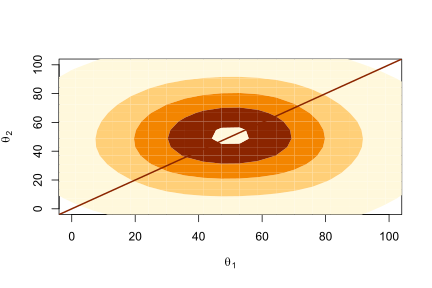
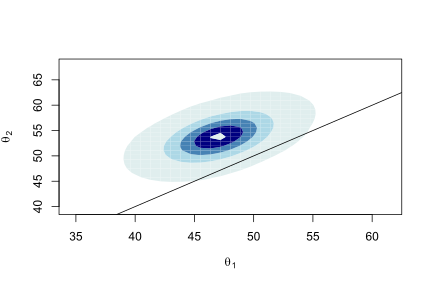
Below are the priors and the posteriors of the variances \(\underline\Sigma_{11},\underline\Sigma_{22}\) and the correlation \(\rho_{12}=\frac{\underline\Sigma_{12}}{\sqrt{\underline\Sigma_{11}\cdot\underline\Sigma_{22}}}\).
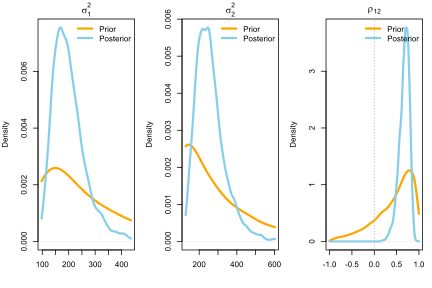
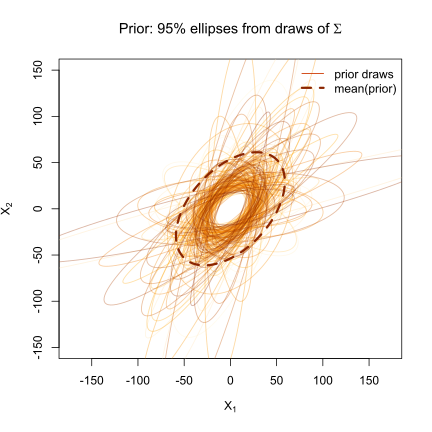
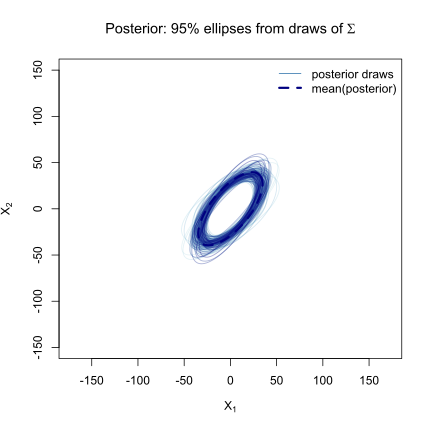
We can visualize the marginal posterior of the 2-by-2 covariance matrix via ellipses. Each ellipse is the 95% contour of a Gaussian with that sampled covariance matrix. The panel with orange ellipses shows the prior draws, the panel with blue ellipses shows the posterior draws. The dashed lines are the ellipses corresponding to the prior and posterior means, respectively.
Below is the HPD region for
\[ \widetilde{\underline{y} } \mid \underline{y}_1, \ldots, \underline{y}_n = \widetilde{y}_{1},\widetilde{y}_{2}\mid \underline{y}_1, \ldots, \underline{y}_n \]
Showing HPD for \(\{97.5\%,75\%,50\%,25\%,2.5\%\}\)
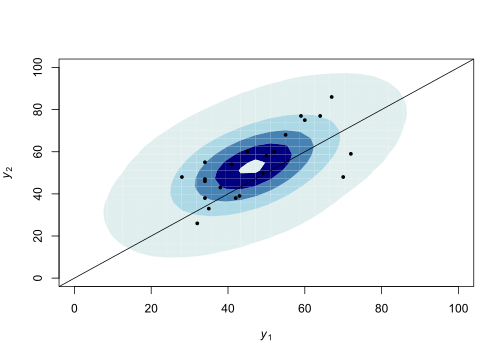
Note, how the regions are shaped similarly for the means \(\theta_j\) as well as predictive values \(\tilde{y}_j\), but the predictive distribution values are more spreadout, as expected.
From the posterior and predictive distributions: \[ Pr(\theta_{1}>\theta_{2}\mid \underline{y}_1, \ldots, \underline{y}_n) \approx 0.99 \qquad Pr(\widetilde{y}_{1}>\widetilde{y}_{2}\mid \underline{y}_1, \ldots, \underline{y}_n) \approx 0.71 \]
Q: What do these probabilities mean in context of the reading comprehension data?
Exercise: Plot diagnostics to investigate convergence of the Gibbs sampler for \(\{\underline{\theta}^{(i)},\underline{\Sigma}^{(i)}\}\):