Lecture 18: Linear Mixed Models and Generalized Linear Mixed Models
1 Learning Objectives
By the end of this lecture, students will be able to:
- Extend hierarchical normal models to hierarchical regression settings
- Derive full conditional distributions for Gibbs sampling in LME models
- Implement Metropolis-Hastings algorithms for GLMMs
- Apply hierarchical Poisson regression to real-world count data
2 Linear Mixed Effects Model/Hierarchical regression
\[ Y_{i, j}=\underline{\beta}_{j}^{T} \underline{x}_{i, j}+\varepsilon_{i, j},\qquad \varepsilon_{i, j} \sim \text { i.i.d. }N\left(0, \sigma^{2}\right) \text {, } \]
Data
- \(Y_{i, j}\) = math score for student \(i\) in school \(j\)
- \(\underline{x}_{i, j}\) = covariate vector for student \(i\) in school \(j\) (intercept and SES)
- \(i \in\{1, \ldots, n_{j}\}\) index of students within school \(j\).
- \(j \in\{1, \ldots, m\}\) index of schools.
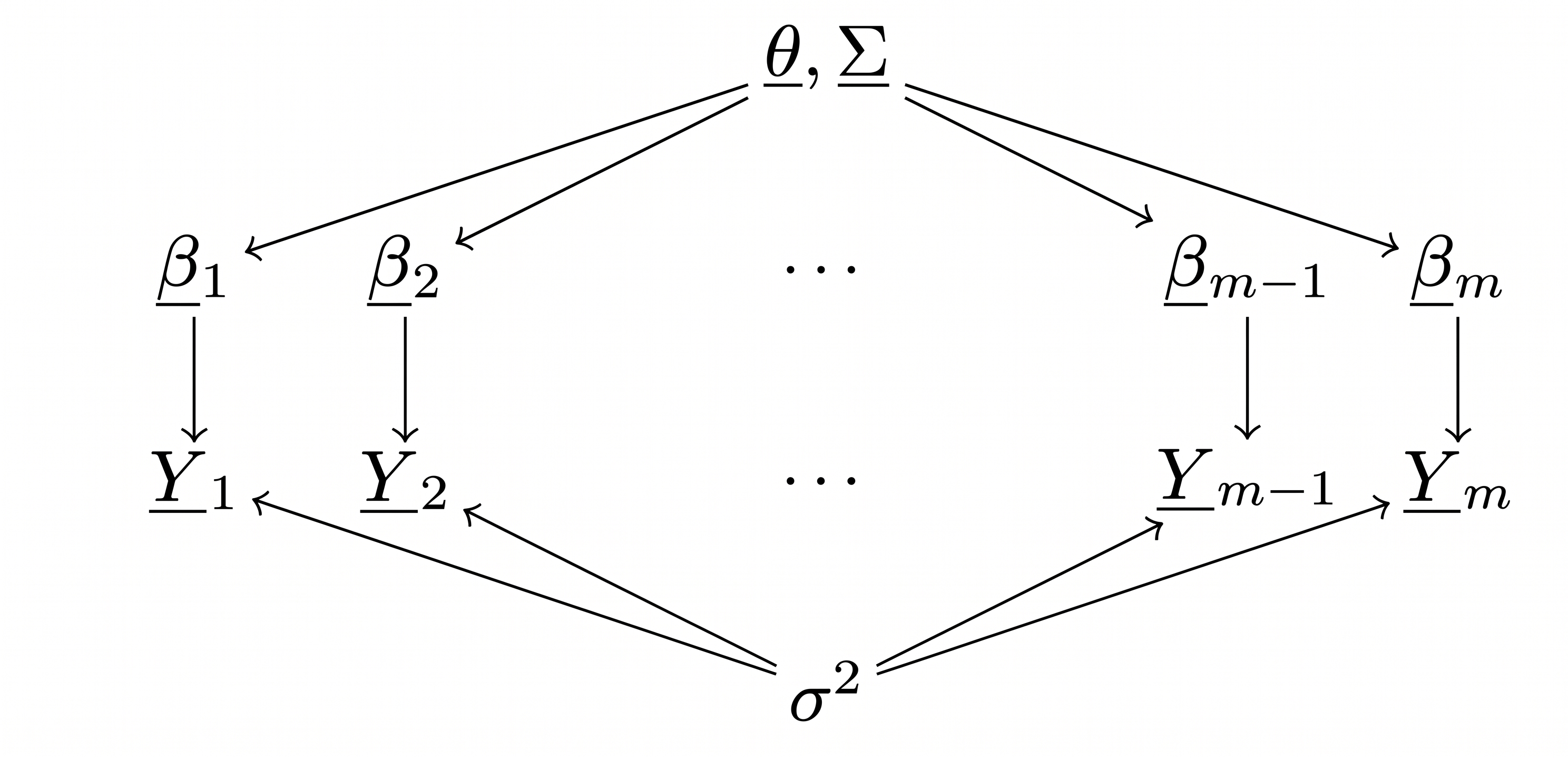
DAG for the hierarchical regression model
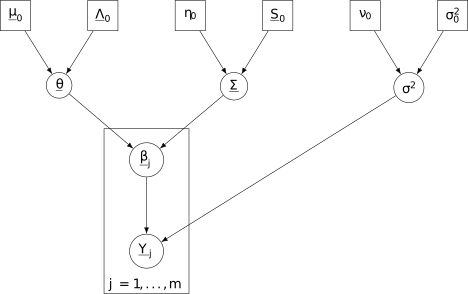
Where we have seen such derivations before?
\[ \begin{aligned} \underline{\beta}_{j} &\mid \underline{y}_{j}, \underline{X}_{j}, \underline{\theta}, \underline{\Sigma}, \sigma^{2} &\\ &&\\ \underline{\theta} &\mid \underline{y}_{j}, \underline{X}_{j}, \underline{\beta}_j, \underline\Sigma, \sigma^{2} &\\ &&\\ \underline{\Sigma} &\mid \underline{y}_{j}, \underline{X}_{j}, \underline{\theta}, \underline{\beta}_j, \sigma^{2} &\\ &&\\ \underline{\sigma}^2 &\mid \underline{y}_{j}, \underline{X}_{j}, \underline{\theta}, \underline\Sigma, \underline{\beta}_j &\\ \end{aligned} \]
3 Full conditional Distributions
Priors
\[ \begin{aligned} \underline{\theta} & \sim \operatorname{MVN} \left(\underline{\mu}_{0}, \Lambda_{0}\right) \\ \underline{\Sigma} & \sim \operatorname{Inverse-Wishart}\left(\eta_{0}, \underline{S}_{0}^{-1}\right) \\ \sigma^{2} & \sim \operatorname{Inverse-Gamma}\left(\nu_{0} / 2, \nu_{0} \sigma_{0}^{2} / 2\right) \end{aligned} \]
Sampling Model
\[ \underline{\beta}_{1}, \ldots, \underline{\beta}_{m} \sim \text { i.i.d. } \text{MVN}(\underline{\theta}, \Sigma) \]
Full conditional Distributions for \(\underline{\beta}_1,\ldots,\underline{\beta}_m\)
\[ \begin{aligned} \underline{\beta}_{j} \mid \underline{y}_{j}, \underline{X}_{j}, \underline{\theta}, \underline\Sigma, \sigma^{2} &\sim {MVN}(m_j,V_j)\\ V_j&=\operatorname{Var}\left[\underline{\beta}_{j} \mid \underline{y}_{j}, \underline{X}_{j}, \sigma^{2}, \underline{\theta}, \underline\Sigma\right] =\left(\Sigma^{-1}+\underline{X}_{j}^{T} \underline{X}_{j} / \sigma^{2}\right)^{-1} \\ m_j&=\mathrm{E}\left[\underline{\beta}_{j} \mid \underline{y}_{j}, \underline{X}_{j}, \sigma^{2}, \underline{\theta}, \underline\Sigma\right] =\left(\underline\Sigma^{-1}+\underline{X}_{j}^{T} \underline{X}_{j} / \sigma^{2}\right)^{-1}\left(\underline\Sigma^{-1} \underline{\theta}+\underline{X}_{j}^{T} \underline{y}_{j} / \sigma^{2}\right) \end{aligned} \]
Full conditional Distributions for \(\underline\theta,\underline\Sigma\)
\[ \begin{aligned} \underline{\theta} \mid \underline{\beta}_{1}, \ldots, \underline{\beta}_{m}, \Sigma & \sim \text { MVN}\left(\underline{\mu}_{m}, \underline\Lambda_{m}\right), \text { where } \\ \underline\Lambda_{m} & =\left(\underline\Lambda_{0}^{-1}+m \underline\Sigma^{-1}\right)^{-1} \\ \underline{\mu}_{m} & =\underline\Lambda_{m}\left(\underline\Lambda_{0}^{-1} \underline{\mu}_{0}+m \underline\Sigma^{-1} \overline{\underline{\beta}}\right) \end{aligned} \]
\[ \begin{aligned} \underline\Sigma \mid \underline{\theta}, \underline{\beta}_{1}, \ldots, \underline{\beta}_{m} & \sim \text { Inverse-Wishart}\left(\eta_{0}+m,\left[\underline{S}_{0}+\underline{S}_{\theta}\right]^{-1}\right), \text { where } \\ \underline{S}_{\theta} & =\sum_{j=1}^{m}\left(\underline{\beta}_{j}-\underline{\theta}\right)\left(\underline{\beta}_{j}-\underline{\theta}\right)^{T} . \end{aligned} \]
Full conditional Distributions for \(\sigma^2\)
\[ \begin{aligned} \sigma^{2}\mid\underline{y},\underline{X},\underline{\beta}_1,\ldots,\underline{\beta}_m & \sim \text {IG}\left(\left[\nu_{0}+\sum n_{j}\right] / 2,\left[\nu_{0} \sigma_{0}^{2}+\mathrm{SSR}\right] / 2\right), \text { where } \\ \mathrm{SSR} & =\sum_{j=1}^{m} \sum_{i=1}^{n_{j}}\left(y_{i, j}-\underline{\beta}_{j}^{T} \underline{x}_{i, j}\right)^{2} . \end{aligned} \]
Results: WWaBD
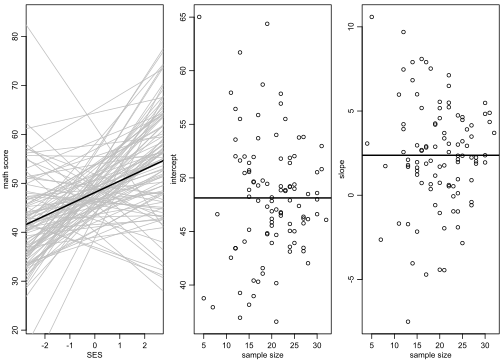
Posterior estimates of school-specific regression lines (gray) with population mean (black).
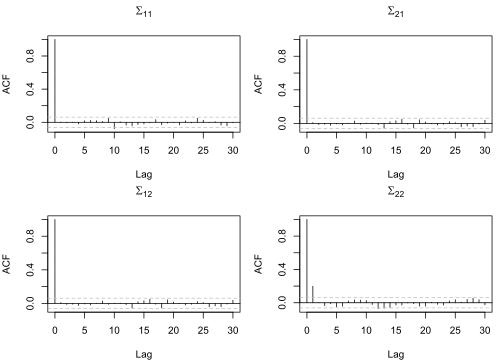
| \[\sigma^2\] | \[\theta_1\] | \[\theta_2\] | \[\Sigma_{11}\] | \[\Sigma_{21}\] | \[\Sigma_{12}\] | \[\Sigma_{22}\] |
|---|---|---|---|---|---|---|
| 849 | 1000 | 1000 | 1000 | 1000 | 1000 | 668 |
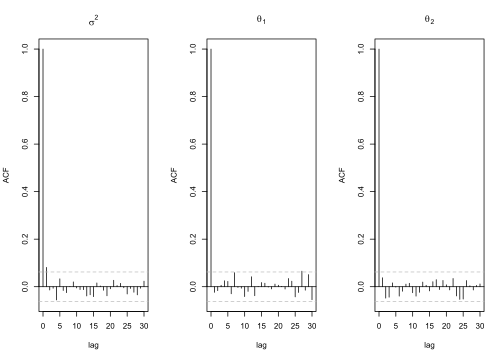
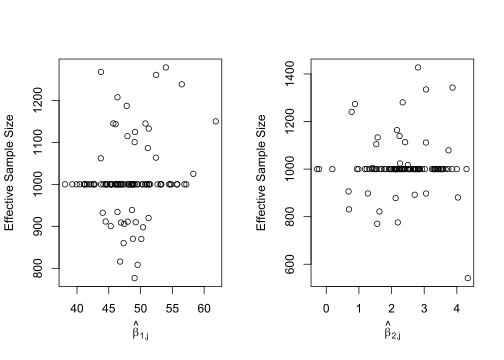
For the parameters \(\beta_{0,j}\) and \(\beta_{1,j}\) the easiest way to assess the quality of the MCMC chain is to look at the plot of the posterior mean of \(\beta_{0,j}\) and \(\beta_{1,j}\) versus their ESS for all schools.
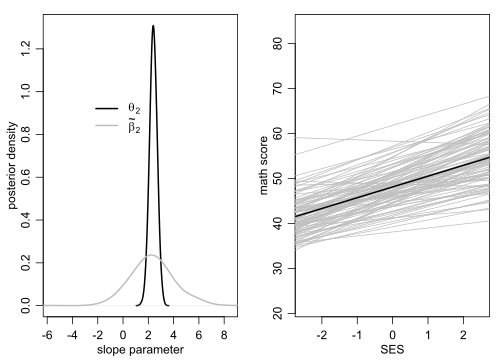
Q: Do you see shrinkage? Which schools are shrunk more?
4 Generalized Linear Mixed Effects Model/Hierarchical GLM
In the previous section, we assumed normally distributed responses. But what if our data are counts, binary outcomes, or other non-normal types? We now extend our framework to handle these cases.


Within Sampling Model
\[ \begin{aligned} p(\underline{y}_{j} \mid \underline{X}_{j}, \underline{\beta}_{j}) & =\hspace{10cm}\\ \end{aligned} \]
5 Metropolis-Hastings=Metropolis+Gibbs
5.1 Gibbs steps for \((\underline{\theta},\underline{\Sigma})\)
\[ \\[3cm] \]
5.2 Metropolis step for \(\underline{\beta}_j\)
Sample \(\underline{\beta}_{j}^{*} \sim\) multivariate normal \(\left(\underline{\beta}_{j}^{(s)}, V_{j}^{(s)}\right)\).
Compute the acceptance ratio
\[ r=\frac{p\left(\underline{y}_{j} \mid \underline{X}_{j}, \underline{\beta}_{j}^{*}\right) p\left(\underline{\beta}_{j}^{*} \mid \underline{\theta}^{(s)}, \underline\Sigma^{(s)}\right)}{p\left(\underline{y}_{j} \mid \underline{X}_{j}, \underline{\beta}_{j}^{(s)}\right) p\left(\underline{\beta}_{j}^{(s)} \mid \underline{\theta}^{(s)}, \underline\Sigma^{(s)}\right)} \]
- Sample \(u \sim\) uniform \((0,1)\). Set \(\underline{\beta}_{j}^{(s+1)}\) to \(\underline{\beta}_{j}^{*}\) if \(u<r\) and to \(\underline{\beta}_{j}^{(s)}\) if \(u>r\).
5.3 A Metropolis-Hastings approximation algorithm
Given current values at scan \(s\) of the Markov chain, we obtain new values as follows:
Sample \(\underline{\theta}^{(s+1)}\) from its full conditional distribution.
Sample \(\underline\Sigma^{(s+1)}\) from its full conditional distribution.
For each \(j \in\{1, \ldots, m\}\),
propose a new value \(\underline{\beta}_{j}^{*}\);
set \(\underline{\beta}_{j}^{(s+1)}\) equal to \(\underline{\beta}_{j}^{*}\) or \(\underline{\beta}_{j}^{(s)}\) with the appropriate probability.
\[ \\[5cm] \]
6 Dataset: Tumor location data
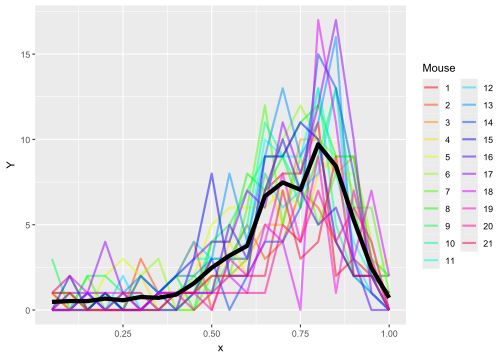
Context: Spatial distribution of tumors in mice along a one-dimensional axis.
6.1 Dataset:
#### Tumor location example
load("../data/tumorLocation.RData")
Y<-tumorLocation
t(head(Y,13))
[,1] [,2] [,3] [,4] [,5] [,6] [,7] [,8] [,9] [,10] [,11] [,12] [,13]
loc1 1 0 1 1 1 0 0 1 3 0 0 0 0
loc2 0 1 0 2 1 0 0 1 0 0 0 0 0
loc3 0 0 0 0 0 0 2 0 2 1 1 0 1
loc4 0 1 0 0 2 0 0 1 2 1 0 0 0
loc5 0 0 1 0 3 0 0 0 1 0 1 2 1
loc6 0 3 1 2 2 2 0 0 0 0 1 0 2
loc7 1 1 0 0 1 3 1 1 0 0 0 1 1
loc8 1 2 0 0 2 0 0 2 0 1 0 2 2
loc9 1 4 1 2 2 0 0 0 1 2 3 4 2
loc10 3 0 2 1 5 1 2 4 4 1 3 3 3
loc11 3 3 2 4 6 2 2 4 5 3 3 3 8
loc12 3 5 3 2 6 3 6 8 7 5 4 3 4
loc13 7 3 5 8 6 7 12 7 9 11 10 8 9
loc14 8 4 5 5 7 10 5 9 9 9 9 6 13
loc15 8 7 10 4 6 12 9 11 6 7 9 7 9
loc16 11 6 10 8 9 10 5 12 9 13 13 8 11
loc17 2 4 8 9 8 9 8 9 13 5 8 13 16
loc18 3 2 9 7 8 9 6 9 6 2 4 3 2
loc19 2 2 3 2 2 4 6 3 2 1 2 1 1
loc20 1 2 0 1 3 0 1 2 2 0 0 0 0Variables: - \(Y_{j,x}\) = number of tumors at location \(x\) for mouse \(j\) - \(x \in \{0.05, 0.10, \ldots, 0.95, 1.00\}\) (20 locations) - \(j \in \{1, 2, \ldots, 21\}\) (21 mice)
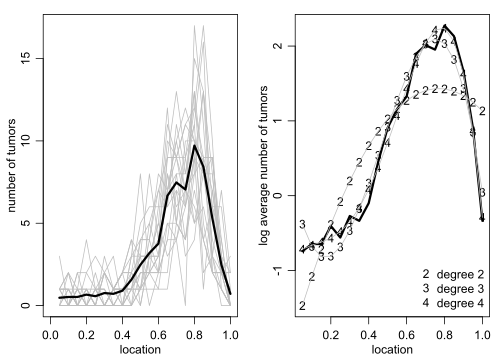
Model: Hierarchical Poisson regression \[ Y_{j,x} \sim \text{Poisson}(\exp(\underline{\beta}_j^T \underline{x})) \] where \(\underline{x}\) includes polynomial basis functions of location.
\[ \\[10cm] \]
EDA: Exploratory data analysis
\[ \\[6cm] \]
Choosing predictors for the hierarchical Poisson regression
7 Results of the Tumor Location dataset analysis
#### MCMC with Caching
cache_file <- "../cache/lecture18_cache.RData"
if(!dir.exists("../cache")) dir.create("../cache", recursive = TRUE)

rmvnorm <- function(n, mu, Sigma) {
    E <- matrix(rnorm(n * length(mu)), n, length(mu))
    t(t(E %*% chol(Sigma)) + c(mu))
  }

if(file.exists(cache_file)) {
  cat("Loading cached MCMC results...\n")
  load(cache_file)
  cat("Loaded", nrow(THETA.post), "MCMC samples\n")
} else {

  cat("Running MCMC (this may take several minutes)...\n")
  #### Tumor location example
  load("../data/tumorLocation.RData")
  Y <- tumorLocation
  ## Helper functions
  rwish <- function(n, nu0, S0) {
    sS0 <- chol(S0)
    S <- array(dim = c(dim(S0), n))
    for(i in 1:n) {
      Z <- matrix(rnorm(nu0 * dim(S0)[1]), nu0, dim(S0)[1]) %*% sS0
      S[,,i] <- t(Z) %*% Z
    }
    S[,,1:n]
  }

  ldmvnorm <- function(X, mu, Sigma, iSigma = solve(Sigma), dSigma = det(Sigma)) {
    Y <- t(t(X) - mu)
    sum(diag(-0.5 * t(Y) %*% Y %*% iSigma)) -
      0.5 * (prod(dim(X)) * log(2*pi) + dim(X)[1] * log(dSigma))
  }

  ## Setup
  xs <- seq(0.05, 1, by = 0.05)
  X <- cbind(rep(1, ncol(Y)), poly(xs, deg = 4, raw = TRUE)); m <- nrow(Y); p <- ncol(X)

  BETA <- NULL
  for(j in 1:m) {
    BETA <- rbind(BETA, lm(log(Y[j,] + 1/20) ~ -1 + X)$coef)
  }

  mu0 <- apply(BETA, 2, mean)
  S0 <- cov(BETA); eta0 <- p + 2; iL0 <- iSigma <- solve(S0)
  THETA.post <- SIGMA.post <- NULL
  set.seed(639)

  for(s in 1:50000) {
    Lm <- solve(iL0 + m * iSigma)
    mum <- Lm %*% (iL0 %*% mu0 + iSigma %*% apply(BETA, 2, sum))
    theta <- t(rmvnorm(1, mum, Lm))

    mtheta <- matrix(theta, m, p, byrow = TRUE)
    iSigma <- rwish(1, eta0 + m,
                    solve(S0 + t(BETA - mtheta) %*% (BETA - mtheta)))

    Sigma <- solve(iSigma)
    dSigma <- det(Sigma)

    for(j in 1:m) {
      beta.p <- t(rmvnorm(1, BETA[j,], 0.5 * Sigma))

      lr <- sum(dpois(Y[j,], exp(X %*% beta.p), log = TRUE) -
                  dpois(Y[j,], exp(X %*% BETA[j,]), log = TRUE)) +
        ldmvnorm(t(beta.p), theta, Sigma, iSigma, dSigma) -
        ldmvnorm(t(BETA[j,]), theta, Sigma, iSigma, dSigma)

      if(log(runif(1)) < lr) BETA[j,] <- beta.p
    }

    if(s %% 10 == 0) {
      THETA.post <- rbind(THETA.post, t(theta))
      SIGMA.post <- rbind(SIGMA.post, c(Sigma))
    }

    if(s %% 10000 == 0) cat("Iteration", s, "\n")
  }
  save(THETA.post, SIGMA.post, BETA, file = cache_file)
  cat("Results saved to:", cache_file, "\n")
}
Loading cached MCMC results...
Loaded 5000 MCMC samples## MCMC diagnostics
load("../data/tumorLocation.RData")
Y <- tumorLocation
xs <- seq(0.05, 1, by = 0.05)
X <- cbind(rep(1, ncol(Y)), poly(xs, deg = 4, raw = TRUE))
m <- nrow(Y)
p <- ncol(X)
library(coda)
round(apply(THETA.post,2,effectiveSize),2) X X1 X2 X3 X4
674.33 1003.23 1092.27 1128.81 1145.48 #### Different posterior regions
eXB.post<-NULL
for(s in 1:dim(THETA.post)[1])
{
beta<-rmvnorm(1,THETA.post[s,],matrix(SIGMA.post[s,],p,p))
eXB.post<-rbind(eXB.post,t(exp(X%*%t(beta) )) )
}
qEB<-apply( eXB.post,2,quantile,probs=c(.025,.5,.975))
eXT.post<- exp(t(X%*%t(THETA.post )) )
qET<-apply( eXT.post,2,quantile,probs=c(.025,.5,.975))
yXT.pp<-matrix( rpois(prod(dim(eXB.post)),eXB.post),
dim(eXB.post)[1],dim(eXB.post)[2] )
qYP<-apply( yXT.pp,2,quantile,probs=c(.025,.5,.975))2.5%, 50% and 97.5% quantiles for \(\exp(\underline{\theta}^T \underline{x})\), \(\exp(\underline{\beta}^T \underline{x})\) and \(\{Y \mid \underline{x}\}\)
#### Figure 11.5
par(mar = c(2.75, 2.75, 2, 0.5), mgp = c(1.7, 0.7, 0))
par(mfrow = c(1, 3))

# Panel 1
plot(c(0,1), range(c(0, qET, qEB, qYP)), type = "n",
     xlab = "location", ylab = "number of tumors",
     main = expression("Population mean " * e^{theta^T * x}))
lines(xs, qET[1,], col = "black", lwd = 1)
lines(xs, qET[2,], col = "black", lwd = 2)
lines(xs, qET[3,], col = "black", lwd = 1)

# Panel 2
plot(c(0,1), range(c(0, qET, qEB, qYP)), type = "n",
     xlab = "location", ylab = "",
     main = expression("Group-specific " * e^{beta^T * x}))
lines(xs, qEB[1,], col = "black", lwd = 1)
lines(xs, qEB[2,], col = "black", lwd = 2)
lines(xs, qEB[3,], col = "black", lwd = 1)

# Panel 3
plot(c(0,1), range(c(0, qET, qEB, qYP)), type = "n",
     xlab = "location", ylab = "",
     main = "Predictive Y|x")
lines(xs, qYP[1,], col = "black", lwd = 1)
lines(xs, qYP[2,], col = "black", lwd = 2)
lines(xs, qYP[3,], col = "black", lwd = 1)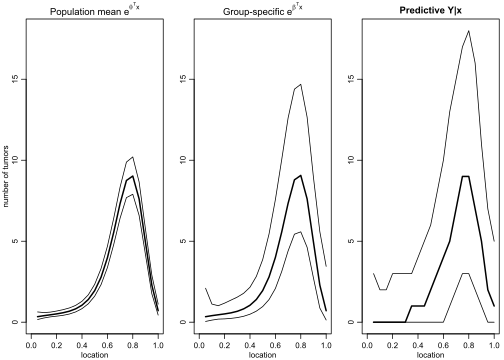
Discussion Questions:
- Why is the predictive interval (right panel) wider than the population mean interval (left)?
- What does the middle panel describe?
- At which locations is tumor count highest? Does this match the EDA?
8 Summary: LMM vs GLMM
| Aspect | LMM | GLMM |
|---|---|---|
| Response | Continuous (Normal) | Count, Binary, etc. |
| Link function | Identity | Log, Logit, etc. |
| \(\beta_j\) sampling | Gibbs (conjugate) | Metropolis-Hastings |
| Computational cost | Lower | Higher |
| Example | Math scores ~ SES | Tumor counts ~ location |
9 Key Takeaways
Hierarchical Regression: Extends hierarchical models to include covariates, allowing both intercepts AND slopes to vary by group.
Shrinkage: Group-specific estimates \(\underline{\beta}_j\) are “shrunk” toward the population mean \(\underline{\theta}\), with more shrinkage for groups with less data.
GLMMs: For non-normal responses, we replace Gibbs steps for \(\underline{\beta}_j\) with Metropolis-Hastings steps.
Mixing Issues: Hierarchical models can have poor MCMC mixing. Check effective sample sizes and consider:
- Longer chains
- Reparameterization (non-centered parameterization)
- More sophisticated samplers (HMC via Stan)